Sciatica refers to irritation of the sciatic nerve that produces pain, tingling, or numbness travelling into the leg. Physiotherapy treatment focuses on reducing nerve sensitivity, improving mobility, and restoring normal movement patterns.
Sciatica : Causes and Impact
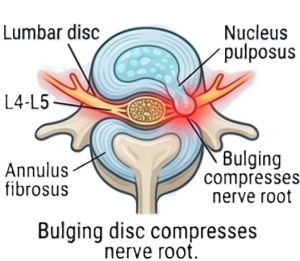
Herniated Disc
What Exactly is a Herniated Disc?
Think of your spinal discs as the “shock absorbers” between your vertebrae. They have a tough outer layer and a gel-like center. A herniation occurs when that center pushes through a crack in the outer layer.
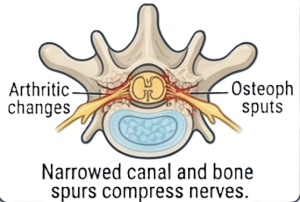
Spinal Stenosis
What is Spinal Stenosis?
Spinal stenosis is a narrowing of the spaces within your spine, which can put pressure on the nerves that travel through the spine to your arms and legs. It most commonly occurs in the lower back (lumbar) and the neck (cervical).
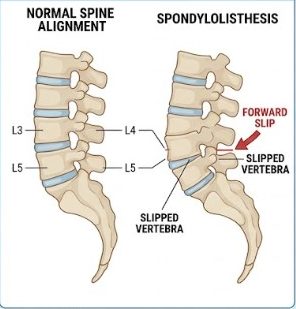
Spondylolisthesis
Spondylolisthesis is a medical condition where one of your vertebrae, the small bones that form the spinal column, slips forward or backward over the bone directly below it.It’s essentially a misalignment of the spinal bones.
While it can happen anywhere in the spine, it’s most common in the lower back (lumbar spine).
Piriformis Syndrome
Piriformis Syndrome occurs when the piriformis muscle compresses or irritates the sciatic nerve. Because the sciatic nerve runs directly underneath (or sometimes through) this muscle, any inflammation or tightness can cause significant pain that radiates down the leg.
How Physiotherapy Helps
Many people worry that movement will make a herniation worse. In reality, movement is medicine. We use an evidence-based approach to take the pressure off your nerves and get you moving again.
Ready to move without limits? Contact us today for a personalized evaluation to find relief from these conditions and start your journey toward lasting wellness