
Cervicogenic Headaches
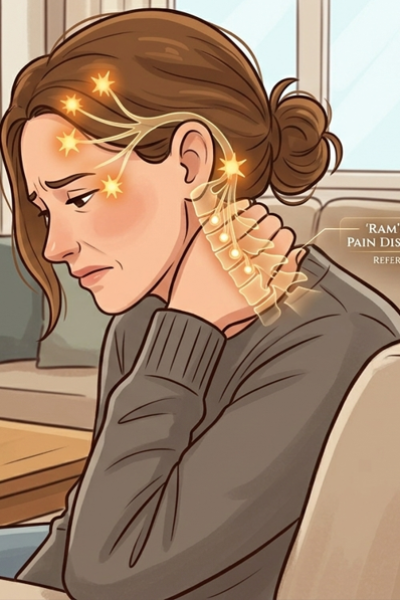
Cervicogenic headaches originate from structures in the neck. Treatment focuses on improving neck mobility, reducing muscular tension, and correcting contributing movement patterns.
What is a Cervicogenic Headache?
Unlike migraines or tension headaches, a cervicogenic headache is a secondary headache. This means it is caused by underlying disc, joint, muscle, or nerve irritation in the upper three segments of your neck.
Common Symptoms
-
One-sided pain: Pain that usually stays on one side of the head.
-
Neck stiffness: Significant loss of range of motion in the neck.
-
Triggered by movement: Pain that worsens with specific neck postures or when pressing on the base of the skull.
-
“Ram’s Horn” pattern: Pain that starts at the base of the skull and wraps over the top of the head toward the eye.
How Physiotherapy Helps
Physiotherapy targets the “root cause” in the neck rather than just masking the head pain. Treatment typically involves a three-pillar approach:
Manual Therapy
We use gentle joint mobilizations to restore movement to stiff cervical segments. By improving the “glide” of the C1-C3 vertebrae, we can reduce the signal of pain being sent to the brain.
Postural Correction
Many CGHs are exacerbated by “Forward Head Posture” (often called “Tech Neck”). We work on strengthening the Deep Neck Flexors—the internal “core” muscles of your neck—to take the pressure off your joints.
Soft Tissue Release
Chronic neck issues often lead to hyper-tonic (overly tight) muscles like the Suboccipitals and Upper Trapezius. Trigger point therapy and dry needling can help “reset” these muscles.